


WizardDetectors
Détecteur de métaux pour le travail du bois Little Wizard 2.5
Détecteur de métaux pour le travail du bois Little Wizard 2.5
Impossible de charger la disponibilité du service de retrait
Le premier Little Wizard a été fabriqué en 1999.
26 ans plus tard, Nouveau pour 2026
Plus intelligent. Plus sonore. Plus facile à utiliser.
Instructions de réglage du Little Wizard :
Le Little Wizard 2.5 est la dernière évolution du détecteur de métaux pour le travail du bois le plus fiable au monde — fièrement conçu et fabriqué par Wizard Industries, Inc., les créateurs originaux du Little Wizard, introduit pour la première fois en 1999.
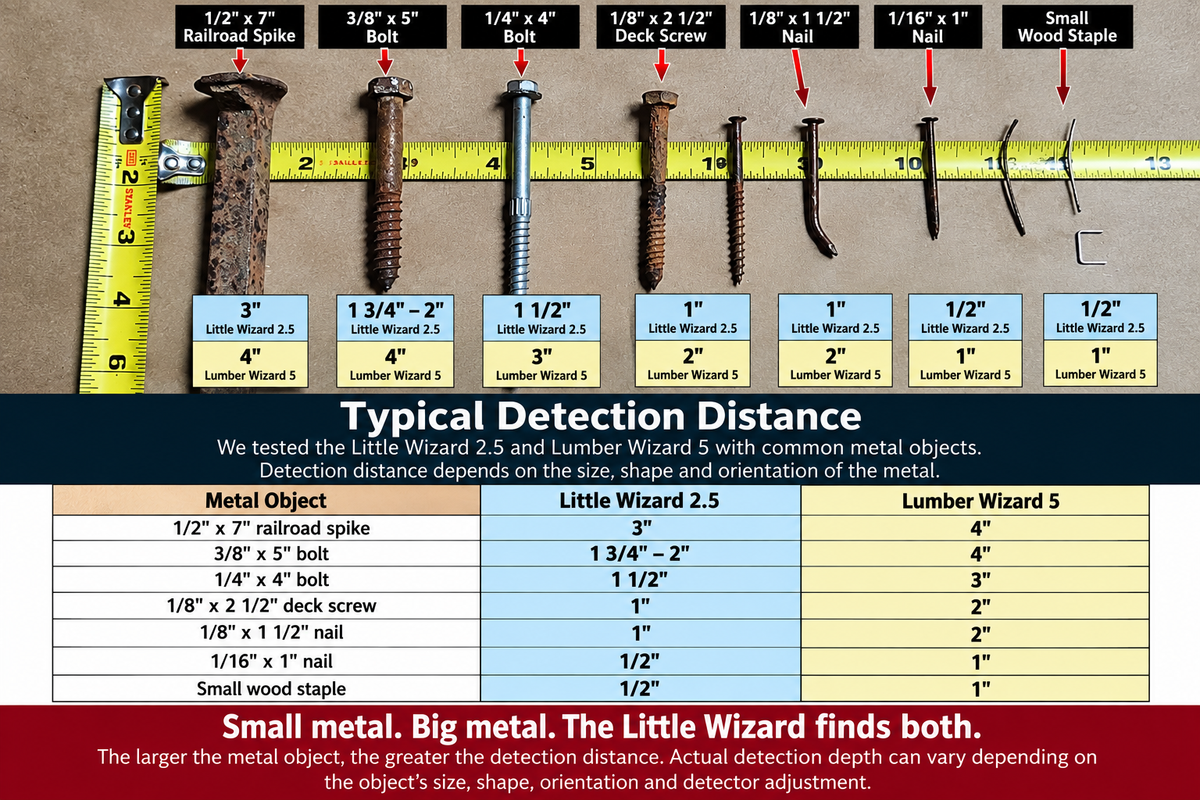
Comparaison des profondeurs de détection du Little Wizard 2.5 et du Lumber Wizard 5.
Depuis plus de vingt ans, les ébénistes, les scieurs et les fabricants de meubles du monde entier se fient au Little Wizard pour protéger leurs lames de scie, leurs couteaux de raboteuse et leurs fers de dégauchisseuse des clous, vis et autres fragments métalliques cachés dans le bois. Le nouveau Little Wizard 2.5 perpétue cette tradition d'innovation et de qualité avec des améliorations bien pensées qui le rendent encore plus facile et plus fiable à utiliser dans les ateliers d'aujourd'hui.
Quoi de neuf dans le Little Wizard 2.5
-
Son amélioré – Alertes plus fortes et plus claires pour une détection précise dans les ateliers bruyants ou avec une protection auditive.
-
Emballage et instructions multilingues – Inclut désormais l'anglais, l'espagnol et le français, le rendant accessible aux travailleurs du bois du monde entier.
-
Conseils de référence rapide sur la face avant – Nouveaux conseils d'utilisation imprimés directement sur la face du détecteur pour une orientation instantanée et facile.
Approuvé par les travailleurs du bois depuis 1999
Le Little Wizard est devenu un outil de sécurité indispensable dans les ateliers de menuiserie, les écoles et les scieries du monde entier. Compact, précis et facile à utiliser, il vous aide à :
-
Détecter les clous, vis, fils et autres métaux cachés dans le bois avant de le couper ou de le raboter.
-
Prévenir les dommages coûteux aux lames de scie et aux outils de coupe.
-
Économiser du temps, des matériaux et de l'argent à chaque projet.

Conçu pour durer
Fabriqué avec des matériaux durables et légers et conçu pour une utilisation à une main, le Little Wizard 2.5 est construit pour des années de service fiable. Il est idéal pour quiconque travaille avec du bois de récupération, du bois brut ou de la menuiserie — des amateurs aux professionnels.






The media could not be loaded.
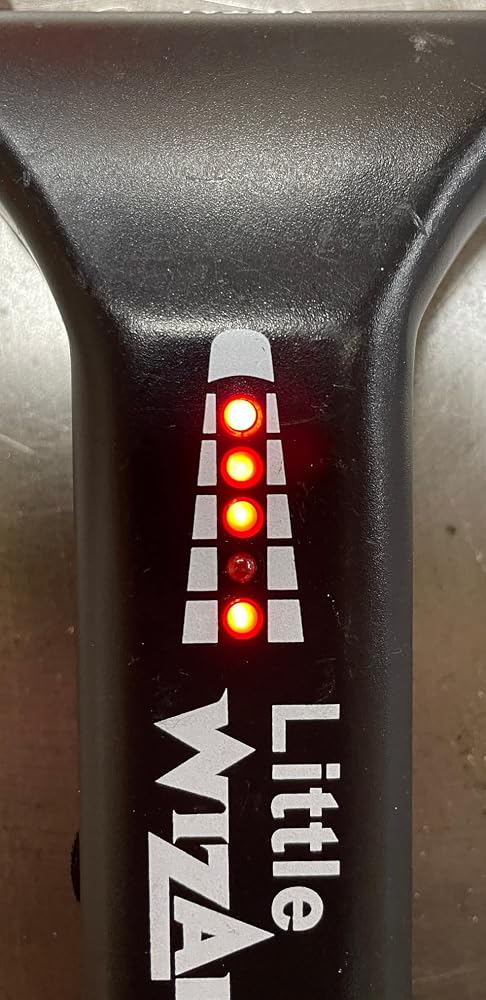
I purchased this Little Wizard II to replace one that finally failed after 14 and a half years of moderate use service. My new Little Wizard II, that I bought in December 2022 but really didn’t use it until early 2023. Shortly after using it I noticed that the fourth LED from the head wasn’t illuminating, so I went to their website and sent them a message through their contact us link because they claim to offer a 1-year warranty. However, this morning when I clicked the Warranty link on their site it said “Not Found The requested URL was not found on this server. Additionally, a 404 Not Found error was encountered while trying to use an ErrorDocument to handle the request”. It’s been a few months now and they haven’t replied as of July 2023.I was using it on some reclaimed cypress and noticed a screw head that had been covered with paint and when I ran the detector over it, it didn’t beep. I checked the battery with my meter, and it was at 9 VDC. I noticed that the leads for the battery holder were exceptionally long and difficult to put back into the battery compartment. I also noticed that when it was assembled, they used cable ties to secure the two halves of the detector: something I’ve never seen before in my 30 years working with power tools. After inserting the battery and replacing the cover I followed their fine-tuning steps, but it still couldn’t detect the screw head.I personally have no confidence in this manufacturer due to their total disregard of after sale support and the corner cutting in the manufacturing of their products. I have five months left before the warranty expires but, what good is a warranty if you can’t contact the company?


I was hoping to find a tool that would help me assess the risk of drilling a hole in wood. The picture shows a small section of a wood rack. I wanted to be able to drill a hole between the existing pegs and couldn't remember whether or not there were any screws in the piece at the location where I needed the new holes. This nail finder worked great. I don't know how 'accurate' it is, but I was able to drill a dozen holes 1-3/8" in diameter with NO problems (i.e., didn't hit any screws).Setup and calibration was a breeze as was using the tool. Every woodworker with wood that has been exposed to metal fasteners could use this.

I bought my Little Wizard II in preparation for resawing some 200 year old beams. My son recommended that I buy one, having bought one several years ago for his woodworking projects, and he is still using it.There were a lot of broken off nails in the beams. They are very brittle and break off easily. The Little Wizard was very accurate and consistently found all the nails that I couldn't see. There is no way I could have resawed those beams without my Little Wizard!

Works great now that I figured out how to use it effectively.
This small metal detector works surprisingly well for such an inexpensive tool. I used it to find nails in some pine boards salvaged from the ceiling of a century-old house. It managed to detect the 2 or 3 nails that I didn't see (and likely would have missed entirely). Bear in mind that you often have to scan the board from more than one direction to detect the nails and this small model isn't likely to find anything in lumber that's very thick (much over one inch). The larger model is probably more sensitive and easier to use, but if you buy this one, you're still won't be throwing your money away.
I've had this tool for about 3 months, and used it on one major project, recovering valuable wood from some old upholstered chairs.In short, it works well, even better than I expected for such an inexpensive device. Used according to the directions it finds nails easily, and if your thorough, will even find skinny little upholstery staples.The device seems well made, I expect it will last a long time.I estimate it's already paid for itself in a single project when I compare it's cost to that of planer, router and saw blades that would otherwise have been damaged.If you work with reclaimed wood you probably need one of these (or the more expensive model if you do lot's of reclaimation).
The first time I used it I found a broken screw and saved the blades in my plainer. Great product
I put a couple of 23ga x 5/8" brads in a pc of 3/4" plywood to try this out. Amazing! This is without a doubt the most accurate metal / nail detector I have ever used. I will have much greater piece of mind now when milling reclaimed wood.
MISSED SMALL NAILS ON HIGHEST SETTING, NEW BATTERIES , CHIPPED NEW PLANER BLADES
Hi, I wish I could have helped. These detectors are very powerful, and knowing how to tune and scan them properly is vital. If you'd like to try again, I would be happy to help guide you. I created these back in 1999, and I am here for you 100%. Thank you, Billy Carmen Wizard Detectors
This is excellent. I should have bought this long ago. Could have saved myself a lot of money on blade sharpening.
I use a lot of recycled lumber and free pallets to make projects. Really helps to save different tools blades by locating hidden metal in the wood. Had been using an old metal detector that was too big, was meant to be used on a beach to find lost jewelry but was free. This handheld model is a great improvement.
I haven't experimented with the settings; but at this point would aim for greater sensitivity.
I was searching for nails in wood recovered from a 100 year old house. I wanted to ensure all nails were removed so I didn't hurt myself or my planer or table saw when I trimmed the wood for new projects. The nail finder seemed very sensitive and seemed to find nails in the wood from both sides of the board, even small tacks and short nails that were buried in the wood. The product emphasizes the need to use a new battery each time. I decided to increase the battery life by turning off the nail finder after using it on each board, because then I would remove all the nails, which might take 5 minutes or more.This seemed to keep the battery fresh, but each time I turned on the nail finder, I had to re-calibrate it, which is a slightly noisy process. After 20 boards, the noise was a little annoying. However, the accuracy at finding nails was very good, so I still give this a high rating.
I have used one of these Little Wizard ll metal detectors for years. It has saved a lot of saw blades, jointer blades and thickness planer blades. There is a small thumb wheel on the side which adjusts the tool’s sensitivity. The little screw that holds the thumb wheel to the tool worked its way loose and disappeared. So I ordered a new one on Amazon. I also sent an email to the company asking what the size of the little screw was or if I could buy one from them. A week later, I received a new thumb wheel and several screws and also a brand new Little Wizard ll. I couldn’t believe it. Talk about great customer service! I could have returned the one I bought on Amazon, but kept it as a back up.
I've been milling a lot of reclaimed wood and you never know when there's some hidden chunk of nail buried somewhere inside. I've successfully avoided ruining my planer blades at least a dozen times already.It's not really useful for pinpoint accuracy but that was never my expectation. That it tells me there *is* something there is useful enough to keep me from running it through my machine until I sort it out. A simple magnet is usually enough to pinpoint it if there's any mystery there.
I wanted to repurpose the wood from some old windows and I know there are buried nails in there. I bought this detector to help me know where I could run it through the table saw. This is not nearly that precise. It does detect the metal every time but the noise starts ‘near’ the nail, like an inch plus. I know this because I dismantled the window to see what was exactly where.I’m sure I could spend a little more for a pinpoint detector. Next time I will. It totally works though, just more broadly than I’d prefer.
I use a lot of reprocessed wood, meaning I must find all of the hidden fasteners imbedded in the old weathered boards from many sources, barns, old sheds, pallets, discarded lumber etc. As the device is used to scan a piece, you will see and hear the presents of metal as it approaches any type of metal.
After reading instructions and installing a battery, very cramped compartment for 9v battery and far too long wires I tested the unit and was amazed that through a 3/4" piece of high grade fiber board it found a 37 thousand Guage piece of steel wire. Further checking revealed finding a staple through 1/8" hardboard, placement found slowly to within +- 1/4 ". I'm convinced.
I purchased a load of rough walnut, and the first piece through the planer came out with four bright shiny spots. Didn't nick the blades, but warned me of possible problems. I bought this detector and flipped the board over to hide the nails, then scanned it from that side. It found all four plus one I hadn't hit yet. I've not yet dug out the five and finished planing, but I suspect that's all of them.
Judging from the shape of the scan head I assumed that I would be able to locate nails anywhere between the two edges ...but this is not the case. It seems like there are 2 sensors 1 inch apart. If the nail is directly over one of those 2 spots then it detects pretty good but if it is not then there is a good chance of it not detecting the object unless the metal object is really big. If you were to scan for a nail that is exactly in the middle of the scan head it will probably not find it. The sensitivity is out of wack once in while so I feel the need to adjust before each use to make sure (this inconvenience is worsen by the fact that the adjustment screw requires a flat to screw driver handy). There is also no indicator to remind you that the unit is turned on.
This little guy makes a great pin-pointer. I am a novice metal detector so I couldn't imagine spending hundreds for a pin-pointer, so I bought one of these. What a great investment! This thing is super helpful and accurate. Well worth the price. Accurate and light, easy to carry with me when I go out into a field or woods. Most importantly this shaves so much time off the digging process and makes the hunt that much more enjoyable. Great little pin-pointer! I would make one adjustment, cover the seem on the front with black electrical tape to keep the dirt out and keeps the pin-pointer accurate.
The media could not be loaded.
I purchased this Little Wizard II to replace one that finally failed after 14 and a half years of moderate use service. My new Little Wizard II, that I bought in December 2022 but really didn’t use it until early 2023. Shortly after using it I noticed that the fourth LED from the head wasn’t illuminating, so I went to their website and sent them a message through their contact us link because they claim to offer a 1-year warranty. However, this morning when I clicked the Warranty link on their site it said “Not Found The requested URL was not found on this server. Additionally, a 404 Not Found error was encountered while trying to use an ErrorDocument to handle the request”. It’s been a few months now and they haven’t replied as of July 2023.I was using it on some reclaimed cypress and noticed a screw head that had been covered with paint and when I ran the detector over it, it didn’t beep. I checked the battery with my meter, and it was at 9 VDC. I noticed that the leads for the battery holder were exceptionally long and difficult to put back into the battery compartment. I also noticed that when it was assembled, they used cable ties to secure the two halves of the detector: something I’ve never seen before in my 30 years working with power tools. After inserting the battery and replacing the cover I followed their fine-tuning steps, but it still couldn’t detect the screw head.I personally have no confidence in this manufacturer due to their total disregard of after sale support and the corner cutting in the manufacturing of their products. I have five months left before the warranty expires but, what good is a warranty if you can’t contact the company?
I was hoping to find a tool that would help me assess the risk of drilling a hole in wood. The picture shows a small section of a wood rack. I wanted to be able to drill a hole between the existing pegs and couldn't remember whether or not there were any screws in the piece at the location where I needed the new holes. This nail finder worked great. I don't know how 'accurate' it is, but I was able to drill a dozen holes 1-3/8" in diameter with NO problems (i.e., didn't hit any screws).Setup and calibration was a breeze as was using the tool. Every woodworker with wood that has been exposed to metal fasteners could use this.
I bought my Little Wizard II in preparation for resawing some 200 year old beams. My son recommended that I buy one, having bought one several years ago for his woodworking projects, and he is still using it.There were a lot of broken off nails in the beams. They are very brittle and break off easily. The Little Wizard was very accurate and consistently found all the nails that I couldn't see. There is no way I could have resawed those beams without my Little Wizard!
Works great now that I figured out how to use it effectively.
This small metal detector works surprisingly well for such an inexpensive tool. I used it to find nails in some pine boards salvaged from the ceiling of a century-old house. It managed to detect the 2 or 3 nails that I didn't see (and likely would have missed entirely). Bear in mind that you often have to scan the board from more than one direction to detect the nails and this small model isn't likely to find anything in lumber that's very thick (much over one inch). The larger model is probably more sensitive and easier to use, but if you buy this one, you're still won't be throwing your money away.
I've had this tool for about 3 months, and used it on one major project, recovering valuable wood from some old upholstered chairs.In short, it works well, even better than I expected for such an inexpensive device. Used according to the directions it finds nails easily, and if your thorough, will even find skinny little upholstery staples.The device seems well made, I expect it will last a long time.I estimate it's already paid for itself in a single project when I compare it's cost to that of planer, router and saw blades that would otherwise have been damaged.If you work with reclaimed wood you probably need one of these (or the more expensive model if you do lot's of reclaimation).
The first time I used it I found a broken screw and saved the blades in my plainer. Great product
I put a couple of 23ga x 5/8" brads in a pc of 3/4" plywood to try this out. Amazing! This is without a doubt the most accurate metal / nail detector I have ever used. I will have much greater piece of mind now when milling reclaimed wood.
MISSED SMALL NAILS ON HIGHEST SETTING, NEW BATTERIES , CHIPPED NEW PLANER BLADES
Hi, I wish I could have helped. These detectors are very powerful, and knowing how to tune and scan them properly is vital. If you'd like to try again, I would be happy to help guide you. I created these back in 1999, and I am here for you 100%. Thank you, Billy Carmen Wizard Detectors
This is excellent. I should have bought this long ago. Could have saved myself a lot of money on blade sharpening.
I use a lot of recycled lumber and free pallets to make projects. Really helps to save different tools blades by locating hidden metal in the wood. Had been using an old metal detector that was too big, was meant to be used on a beach to find lost jewelry but was free. This handheld model is a great improvement.
I haven't experimented with the settings; but at this point would aim for greater sensitivity.
I was searching for nails in wood recovered from a 100 year old house. I wanted to ensure all nails were removed so I didn't hurt myself or my planer or table saw when I trimmed the wood for new projects. The nail finder seemed very sensitive and seemed to find nails in the wood from both sides of the board, even small tacks and short nails that were buried in the wood. The product emphasizes the need to use a new battery each time. I decided to increase the battery life by turning off the nail finder after using it on each board, because then I would remove all the nails, which might take 5 minutes or more.This seemed to keep the battery fresh, but each time I turned on the nail finder, I had to re-calibrate it, which is a slightly noisy process. After 20 boards, the noise was a little annoying. However, the accuracy at finding nails was very good, so I still give this a high rating.
I have used one of these Little Wizard ll metal detectors for years. It has saved a lot of saw blades, jointer blades and thickness planer blades. There is a small thumb wheel on the side which adjusts the tool’s sensitivity. The little screw that holds the thumb wheel to the tool worked its way loose and disappeared. So I ordered a new one on Amazon. I also sent an email to the company asking what the size of the little screw was or if I could buy one from them. A week later, I received a new thumb wheel and several screws and also a brand new Little Wizard ll. I couldn’t believe it. Talk about great customer service! I could have returned the one I bought on Amazon, but kept it as a back up.
I've been milling a lot of reclaimed wood and you never know when there's some hidden chunk of nail buried somewhere inside. I've successfully avoided ruining my planer blades at least a dozen times already.It's not really useful for pinpoint accuracy but that was never my expectation. That it tells me there *is* something there is useful enough to keep me from running it through my machine until I sort it out. A simple magnet is usually enough to pinpoint it if there's any mystery there.
I wanted to repurpose the wood from some old windows and I know there are buried nails in there. I bought this detector to help me know where I could run it through the table saw. This is not nearly that precise. It does detect the metal every time but the noise starts ‘near’ the nail, like an inch plus. I know this because I dismantled the window to see what was exactly where.I’m sure I could spend a little more for a pinpoint detector. Next time I will. It totally works though, just more broadly than I’d prefer.
I use a lot of reprocessed wood, meaning I must find all of the hidden fasteners imbedded in the old weathered boards from many sources, barns, old sheds, pallets, discarded lumber etc. As the device is used to scan a piece, you will see and hear the presents of metal as it approaches any type of metal.
After reading instructions and installing a battery, very cramped compartment for 9v battery and far too long wires I tested the unit and was amazed that through a 3/4" piece of high grade fiber board it found a 37 thousand Guage piece of steel wire. Further checking revealed finding a staple through 1/8" hardboard, placement found slowly to within +- 1/4 ". I'm convinced.
I purchased a load of rough walnut, and the first piece through the planer came out with four bright shiny spots. Didn't nick the blades, but warned me of possible problems. I bought this detector and flipped the board over to hide the nails, then scanned it from that side. It found all four plus one I hadn't hit yet. I've not yet dug out the five and finished planing, but I suspect that's all of them.
Judging from the shape of the scan head I assumed that I would be able to locate nails anywhere between the two edges ...but this is not the case. It seems like there are 2 sensors 1 inch apart. If the nail is directly over one of those 2 spots then it detects pretty good but if it is not then there is a good chance of it not detecting the object unless the metal object is really big. If you were to scan for a nail that is exactly in the middle of the scan head it will probably not find it. The sensitivity is out of wack once in while so I feel the need to adjust before each use to make sure (this inconvenience is worsen by the fact that the adjustment screw requires a flat to screw driver handy). There is also no indicator to remind you that the unit is turned on.
This little guy makes a great pin-pointer. I am a novice metal detector so I couldn't imagine spending hundreds for a pin-pointer, so I bought one of these. What a great investment! This thing is super helpful and accurate. Well worth the price. Accurate and light, easy to carry with me when I go out into a field or woods. Most importantly this shaves so much time off the digging process and makes the hunt that much more enjoyable. Great little pin-pointer! I would make one adjustment, cover the seem on the front with black electrical tape to keep the dirt out and keeps the pin-pointer accurate.